
Written by Senior Foreign Counsel Vaibhav Saxena
Vietnam has taken another significant step in modernising its investment framework with the issuance of Decree No. 274/2026/NĐ-CP (“Decree 274”), which provides detailed guidance on investor selection for business investment projects under the Law on Bidding. Effective from 21 August 2026, the Decree replaces the fragmented implementing regime previously contained in Decree No. 23/2024/NĐ-CP, Decree No. 115/2024/NĐ-CP and the relevant amendments introduced by Decree No. 225/2025/NĐ-CP, while also amending certain provisions governing BT (Build-Transfer) projects under Decree No. 257/2025/NĐ-CP.
Although Decree 274 is formally an implementing regulation, its significance extends beyond procurement. It consolidates investor selection into a single procedural framework while aligning procurement with the Law on Bidding, Land Law, Law on Investment and other sector-specific legislation. In doing so, it reinforces the Government’s broader objective of integrating investment approval, land administration, procurement and project implementation into a more coherent regulatory system.
For investors, developers and lenders, this represents an important shift in approach. Investor selection should no longer be regarded simply as a tender process preceding project implementation. Instead, procurement becomes one stage within a continuous regulatory lifecycle, where decisions made during investor selection may directly influence investment licensing, contractual obligations, financing arrangements and future project restructuring.
While the Decree does not fundamentally alter Vietnam’s procurement policy, it provides greater procedural certainty, modernises procurement administration and clarifies how investor selection interacts with the wider legal framework governing business investment projects.
From Procurement to Project Structuring
Perhaps the most significant message emerging from Decree 274 is that procurement should no longer be regarded as a standalone legal exercise.
Historically, many investors approached procurement after completing commercial negotiations, financing arrangements or preliminary investment planning. Under the new framework, that sequence becomes increasingly difficult to maintain. Procurement considerations now influence project structure from the outset, particularly where investor selection is mandatory under the Land Law or sector-specific legislation.
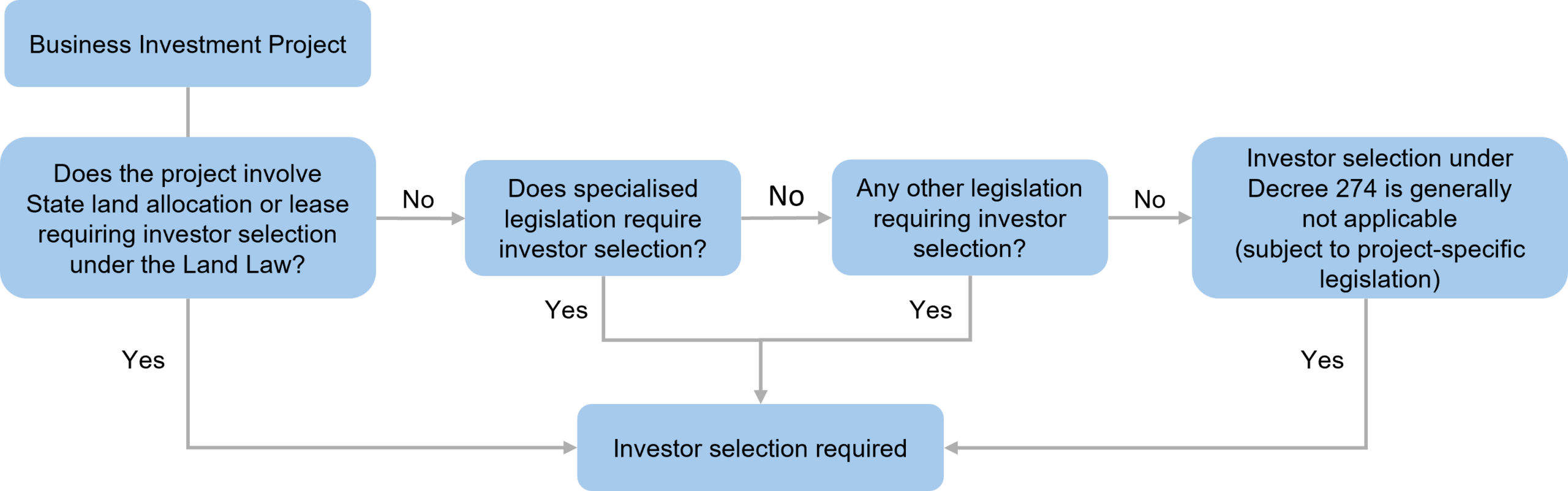
Accordingly, legal due diligence should begin with a fundamental question: does the proposed project require investor selection?
Only after establishing the applicable procurement pathway should investors determine investment structure, consortium arrangements, financing strategy, land acquisition and implementation planning. Incorrectly characterising the procurement regime at the outset may result in significant regulatory delays that are considerably more difficult to remedy after project development has commenced.
Projects Requiring Investor Selection
Decree 274 identifies the categories of business investment projects that are subject to investor selection.
The first category comprises projects involving land allocation or land lease where investor selection is required under the Land Law. In these cases, procurement forms part of the State’s land allocation mechanism rather than a separate administrative process. Land strategy should therefore be considered together with procurement and investment planning from the earliest stage of project development.
The second category includes projects where specialised legislation independently requires investor selection. Decree 274 expressly refers to sectors including urban development, apartment reconstruction, water supply, waste treatment, environmental infrastructure, electricity, airports, education and healthcare. The practical implication is that investor selection is not confined to land-use projects. Sector-specific legislation may impose procurement obligations even where land recovery is not the determining factor.
Finally, the Decree accommodates future categories of projects that may become subject to investor selection under subsequent legislation. This drafting approach provides flexibility as Vietnam continues to refine its investment framework.
From a commercial perspective, determining whether investor selection applies should be one of the earliest legal assessments undertaken for any significant investment. It influences project timetable, transaction structure, financing strategy and implementation planning and should therefore precede many of the commercial decisions that traditionally occur at the beginning of project development.
Building a Competitive Procurement Strategy
Competition and Independence: Procurement Integrity Takes Centre Stage
One of the most important practical themes emerging from Decree 274 is the increased emphasis on procurement integrity. While the Law on Bidding has long required competition and transparency, Decree 274 provides more detailed guidance on the independence requirements applicable to investors and other participants throughout the investor selection process.
This reflects a broader regulatory trend. As Vietnam continues to attract increasingly sophisticated domestic and international investment, regulators are placing greater emphasis on ensuring that procurement outcomes are determined through genuine competition rather than commercial relationships or structural advantages.
For international investors, this means that procurement compliance should no longer be assessed solely from the perspective of the bidding entity. Ownership structures, consortium arrangements, strategic partnerships, technical advisers and financing relationships should all be reviewed to ensure they do not compromise the independence requirements prescribed under procurement legislation.
The issue is particularly relevant for infrastructure and energy projects, where consortium structures have become increasingly common. Such arrangements remain fully permissible and often commercially necessary. However, consortium members should establish clear governance arrangements before procurement commences, including the allocation of technical responsibilities, financial commitments, decision-making authority and responsibility for preparing procurement documents. Early coordination reduces inconsistencies between legal, financial and technical submissions while demonstrating organisational capability during evaluation.
The same consideration applies to consultants engaged during project preparation. Investors should ensure that advisers performing multiple roles throughout project development continue to satisfy applicable independence requirements, particularly where advisory services extend across procurement, project preparation and implementation.
Although these principles are not entirely new, Decree 274 indicates that procurement integrity is likely to receive greater regulatory scrutiny. Investors participating in major procurement exercises should therefore undertake procurement compliance reviews alongside traditional legal due diligence to identify any structural issues before bidding begins.
Evaluation Is Increasingly About Capability Rather Than Price
Perhaps the clearest policy direction reflected in Decree 274 is Vietnam’s continuing movement away from purely price-driven procurement.
Decree 274 provides guidance on investor preferences during evaluation. Importantly, these preferences should not be confused with investment incentives under the Law on Investment. Rather, they influence how competing investors are assessed during the procurement process itself.
This distinction is commercially significant.
Historically, procurement often focused primarily on financial capacity and commercial terms. Decree 274 reinforces a broader evaluation framework that increasingly recognises implementation capability, technological sophistication, environmental performance and operational experience as indicators of long-term project success.
For many international investors, these are areas of comparative strength. Experience in delivering complex infrastructure projects, advanced engineering solutions, ESG implementation, technology transfer and sophisticated operational management may now represent important competitive advantages when procurement documentation incorporates these evaluation criteria.
Accordingly, procurement submissions should no longer be prepared as legal or commercial documents alone. Successful bids are increasingly the product of coordinated input from lawyers, engineers, financial advisers, environmental specialists and project managers, presenting a coherent implementation strategy rather than a collection of separate technical submissions.
The practical implication is straightforward. Investors should approach procurement as an opportunity to demonstrate how they will successfully deliver the project over its entire lifecycle rather than simply explaining why they satisfy minimum qualification requirements.
Market Interest Procedures: Greater Transparency Before Formal Procurement
Decree 274 also significantly expands the regulation of market interest procedures conducted before formal investor selection.
The Decree provides comprehensive guidance governing the preparation and publication of invitation documents, clarification procedures, amendments, evaluation methodology and approval processes. Although many of these procedural requirements existed under previous regulations, they are now consolidated within a single implementing framework, improving consistency across different categories of projects.
One important safeguard introduced by the Decree is the requirement that procurement documentation must not contain conditions that unnecessarily restrict competition or create unfair advantages for particular investors. This reinforces the Government’s broader objective of promoting transparent and competitive procurement while reducing the likelihood of complaints or procurement cancellations arising from inappropriate evaluation criteria.
For investors, the commercial lesson is equally important. Procurement documents should be reviewed carefully immediately following publication. Where qualification criteria, technical specifications or evaluation methodology appear inconsistent with the Law on Bidding or Decree 274, clarification should be sought during the prescribed procurement period. Waiting until after submission or completion of evaluation may significantly limit the practical options available to investors.
Investor Selection Methods: A Unified Procedural Framework
Another practical benefit of Decree 274 is the consolidation of the procedural rules governing investor selection methods.
Rather than requiring investors to consult multiple implementing regulations, the Decree establishes a single procedural framework governing the principal methods available under the Law on Bidding, including open bidding, limited bidding where permitted by law, investor appointment in prescribed circumstances and other specialised procedures.
Although the applicable procurement method continues to be determined by legislation rather than commercial preference, bringing these procedures together within one implementing decree significantly improves legal certainty and reduces administrative complexity.
This consolidation should also assist investors during the early planning stages of projects. Identifying the applicable procurement pathway before significant resources are committed allows investors to better estimate procurement timelines, transaction costs and competitive risks while aligning procurement planning with financing and investment approval processes.
Digital Procurement Is Becoming a Strategic Consideration
One of the most consequential reforms introduced by Decree 274 is the continued expansion of electronic procurement.
The National E-Procurement System is no longer simply an electronic filing platform. It increasingly functions as the central administrative infrastructure supporting investor selection by facilitating publication of procurement information, submission of electronic dossiers, clarification requests, bid opening and publication of procurement results. The Decree also establishes a phased roadmap towards broader implementation of electronic investor selection across different authorities and project categories.
This digital transformation reflects a wider shift in public procurement. Administrative efficiency remains important, but equally significant are transparency, traceability and consistency throughout the procurement process.
For investors, electronic procurement should therefore be viewed as a governance issue rather than merely a technological one. Internal approval procedures, electronic signature requirements, document management systems and coordination among consortium members become increasingly important as procurement moves further into a digital environment where procedural deficiencies may be more difficult to correct after submission.
Investors with mature compliance systems are therefore likely to enjoy practical advantages, particularly where they participate regularly in large-scale procurement exercises.
The National Database on Investors: Procurement Information as a Strategic Asset
Closely linked to the expansion of electronic procurement is the further development of the National Database on Investors.
Rather than requiring repeated submission of corporate information for every procurement exercise, the database is intended to serve as a central repository supporting investor selection and subsequent regulatory supervision.
Although this reform may initially appear administrative in nature, it has broader commercial implications. For repeat investors, accurate and consistent corporate information will increasingly become part of procurement readiness. Maintaining reliable records within the national database should reduce administrative burden while facilitating more efficient participation in future procurement exercises.
Over time, the database may also contribute to greater consistency in regulatory decision-making by providing authorities with a centralised source of investor information throughout different stages of project development.
Procurement Commitments No Longer End at Award
One of the most significant features of Decree 274 is that it substantially reduces the distinction between procurement and project implementation.
Historically, investor selection was often viewed as a competitive exercise that concluded once the successful bidder had been appointed. Thereafter, attention shifted to investment licensing, project documentation and implementation under separate legal frameworks. Although many commitments made during procurement influenced subsequent negotiations, they were frequently regarded as commercial proposals rather than long-term legal obligations.
Decree 274 adopts a different approach.
Through its detailed provisions on project contracts and implementation, the Decree makes clear that investor selection represents the beginning—not the conclusion—of the project’s regulatory lifecycle. Commitments made during procurement are expected to carry through into project implementation and, in many cases, become binding contractual obligations governing project delivery.
This represents an important shift for investors. Procurement submissions should no longer be prepared solely with the objective of securing a competitive advantage. They should also be prepared with the expectation that key representations regarding implementation capability, technology, financing and project delivery may subsequently form part of the contractual framework governing the project.
Accordingly, investors should ensure that commitments made during procurement accurately reflect what can realistically be delivered throughout the project lifecycle.
Project Contracts Become Central to Regulatory Compliance
Reflecting this shift, Decree 274 provides considerably more detailed guidance on project contracts contained in Appendix III, than previous implementing regulations. However, in a basic form Model contract which need to be negotiated to form as a comprehensive template contract for practical reliance by the authorities in the future course for sectorial projects.
Rather than prescribing a rigid contractual template, the Appendix establishes a structured framework covering matters such as contractual hierarchy, implementation milestones, financing obligations, project company arrangements, environmental and technology commitments, rights and obligations of the parties and dispute resolution. This promotes greater consistency across sectors while preserving sufficient flexibility to accommodate project-specific requirements.
The practical significance extends beyond contract drafting.
Successful procurement submissions increasingly become the foundation upon which project contracts are negotiated. Commitments regarding implementation schedules, investment capital, technology standards, environmental performance and other aspects of project delivery should therefore be regarded as obligations capable of contractual enforcement rather than aspirational statements made solely for evaluation purposes.
From a commercial perspective, this reduces the scope for material divergence between procurement proposals and implementation arrangements after project award. Investors should therefore approach procurement documentation with the same degree of internal review that would ordinarily be applied to financing agreements or transaction documents.
Project Companies Do Not Create a New Legal Relationship
Large infrastructure, energy and real estate projects are frequently implemented through special purpose vehicles established after investor selection.
Decree 274 confirms that this corporate structure does not interrupt the continuity between procurement and implementation. Where a project company is established, it succeeds to the rights and obligations assumed by the successful investor during procurement and under the project contract. The creation of a new legal entity therefore does not relieve investors of commitments previously undertaken during investor selection.
The project company must continue to implement the project in accordance with the project contract and the broader legal framework governing investment, enterprises, land, construction, real estate business and other applicable legislation.
This clarification is particularly important for foreign investors and project sponsors who regularly establish dedicated project companies following procurement. The corporate restructuring commonly undertaken after project award should not be viewed as creating a fresh legal relationship with the authorities. Instead, the project company effectively steps into the implementation role while assuming responsibility for obligations established during procurement.
Implementation Obligations Extend Well Beyond Construction
Decree 274 recognises that successful project delivery depends upon effective implementation rather than successful procurement alone.
Accordingly, the Decree establishes a detailed framework governing post-award implementation by both the successful investor and, where applicable, the project company.
One important requirement is the provision of performance security in accordance with the Law on Bidding. For projects implemented in stages, the Decree allows performance security to be structured and released on a phased basis where agreed under the project contract. This provides useful flexibility for long-term infrastructure and industrial developments where implementation may extend over many years.
The Decree also reinforces the close relationship between procurement and land administration. For projects involving State land recovery, the successful investor or project company is required to advance funding for compensation, support and resettlement in accordance with the Land Law. Failure to provide the required funding after a request from the competent authority may affect the investor’s entitlement to recover its performance security.
These provisions demonstrate that implementation obligations should not be viewed as separate administrative matters arising after procurement. Rather, they form part of the commercial and financial planning that should be undertaken before bids are submitted. Funding requirements associated with compensation, land clearance and performance security should therefore be incorporated into financial models at an early stage rather than addressed only after project award.
Transfer Restrictions Influence Investment Strategy
Another commercially significant aspect of Decree 274 concerns restrictions on project transfers before commercial operation.
The Decree provides that transfers of shares or capital contributions in the project company before the project becomes operational remain subject to specific regulatory conditions. In addition to obtaining any required approvals from the competent authority, the proposed transferee must satisfy the applicable legal requirements under investment, enterprise, land, real estate and sector-specific legislation while assuming the rights and obligations previously undertaken by the transferring investor.
Only after commercial operation has commenced do transfers generally become subject to the ordinary rules of enterprise law, unless sector-specific legislation provides otherwise.
Although these provisions primarily regulate implementation, their practical implications arise much earlier.
Infrastructure funds, private equity investors, consortium participants and strategic investors frequently consider refinancing, restructuring or staged exits well before project completion. Decree 274 reinforces that such strategies should be considered during transaction structuring rather than after procurement has concluded.
For lenders, the provisions are equally relevant. Security enforcement, changes in ownership and restructuring transactions may all require consideration of procurement-related obligations alongside conventional corporate law analysis.
In this respect, Decree 274 further demonstrates that procurement law increasingly influences transaction planning throughout the life of a project rather than merely governing the investor selection process.
Practical Implications and Looking Ahead
Managing the Transition to the New Framework
Legislative reform inevitably raises questions for projects already in progress. Recognising this, Decree 274 contains comprehensive transitional provisions intended to preserve legal certainty while facilitating implementation of the new framework.
Rather than requiring all ongoing procurements to restart under the new regime, the Decree allows certain procurement activities commenced before its effective date to continue under the previous regulations where the applicable transitional conditions are satisfied. It also provides guidance where future legislative amendments add or remove categories of projects that require investor selection.
Although transitional provisions are often regarded as administrative, they can have significant commercial consequences. Large infrastructure and real estate projects frequently progress over several years, during which different stages of procurement, investment approval and implementation may fall under different legislative regimes.
Investors involved in ongoing procurement exercises should therefore undertake an early legal review to determine which procedural framework governs each stage of the project. Resolving transitional issues at the outset is generally far less disruptive than attempting to address them once procurement or implementation has advanced.
Transition
Legislative reform inevitably raises questions regarding projects already in progress. Decree 274 therefore contains comprehensive transitional provisions designed to ensure continuity while implementing the new regulatory framework.
The Decree permits certain procurement activities initiated before its effective date to continue under the previous regulations in specified circumstances, thereby reducing disruption to ongoing projects. It also provides guidance where sector-specific legislation is subsequently amended to add or remove categories of projects requiring investor selection.
For investors with ongoing procurement processes, an early assessment of the applicable transitional regime is essential. Different stages of the same project may be governed by different procedural rules depending on when particular procurement steps were completed.
What Investors Should Do Differently
The practical lessons emerging from Decree 274 extend beyond procedural compliance.
First, investor selection should be considered at the earliest stage of project planning rather than after commercial decisions have already been made. Determining whether procurement applies will often shape investment structure, project timetable and financing strategy.
Second, procurement documentation should be prepared on the assumption that important commitments may later become contractual obligations. Investors should therefore ensure that implementation schedules, financing assumptions and technical commitments accurately reflect the project’s intended delivery strategy.
Third, internal governance deserves greater attention. As procurement becomes increasingly digital and implementation obligations more detailed, investors should establish robust internal procedures for document management, approvals, consortium coordination and procurement compliance.
Finally, procurement should no longer be managed independently of investment, financing and implementation workstreams. A coordinated approach across legal, commercial, technical and financial advisers is increasingly essential to reducing implementation risk.
Investor Checklist
Before participating in an investor selection process, investors should confirm that they have:
- determined whether the project is legally subject to investor selection;
- considered the interaction between procurement, investment, land and sector-specific legislation;
- reviewed ownership structures and consortium arrangements for compliance with competition and independence requirements;
- established appropriate governance for electronic procurement and document management;
- ensured that procurement commitments align with financing assumptions and implementation capability;
- reviewed project contract provisions, including performance security and transfer restrictions; and
- assessed whether transitional provisions affect any ongoing procurement activities.
Annex 1 – Determining Whether Investor Selection Is Required
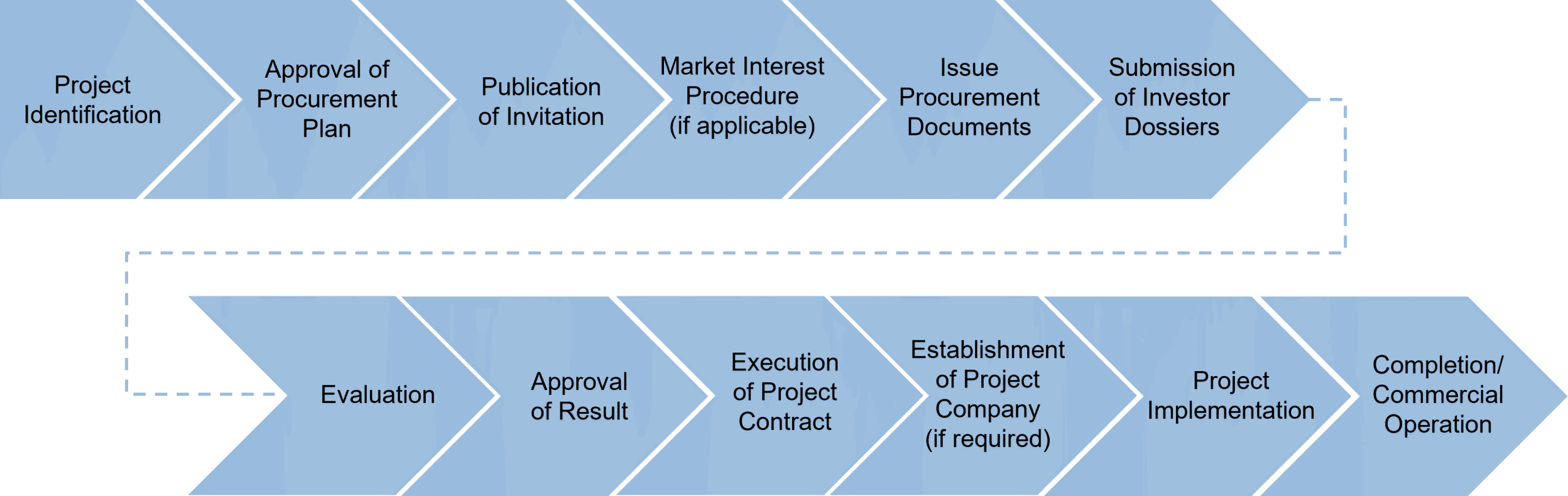
Annex 2 – Investor Selection Lifecycle