
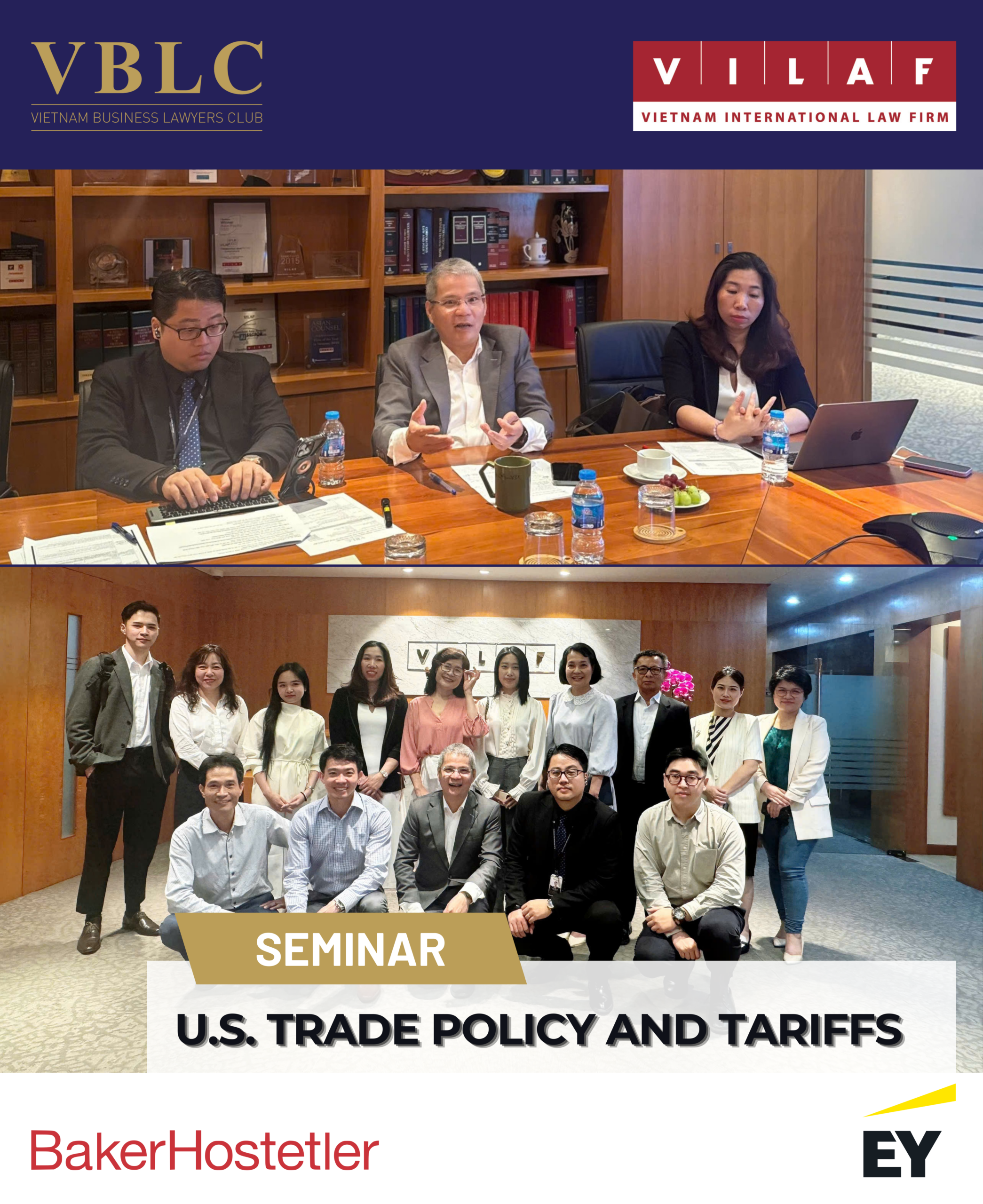
 VILAF was pleased to co-sponsor the seminar on U.S. trade and tariff policies and their impact on Vietnamese businesses, hosted by the Vietnam Business Lawyers Club (VBLC), with speakers from VILAF, BakerHostetler, and EY Consulting Vietnam.
Held both in person at VILAF’s Hanoi Office and via Zoom on 31 March 2026, the seminar examined the implications of two ongoing Section 301 investigations, following the U.S. Supreme Court’s rejection of the International Emergency Economic Powers Act (IEEPA) as a legal basis for imposing certain tariffs. These developments underscore the growing impact of U.S. trade enforcement on Vietnamese exports and raise concerns regarding potential effects on Vietnam’s manufacturing sector and foreign direct investment (FDI) inflows.
VILAF’s Hanoi Office Managing Partner, Anh Bui, participated as a panel speaker, sharing insights on strategies for Vietnamese businesses in navigating evolving trade and tariff dynamics.
Three key takeaways:
- Rising tariff exposure: The Section 301 investigations present a risk of increased tariffs on Vietnamese exports, with potential implications for manufacturing operations and future FDI into Vietnam.
- Critical importance of compliance: Vietnamese exporters are strongly encouraged to cooperate fully and proactively with U.S. authorities in all investigations, including those conducted by the U.S. Department of Commerce (DOC) and the International Trade Commission (ITC), in order to preserve access to the U.S. market.
- Value of preparedness: Maintaining detailed records of input materials, manufacturing processes, and cost structures for U.S.-bound exports is essential to supporting exporters’ positions and achieving more favourable outcomes.
Looking ahead, it is expected that the Government of Vietnam will seek a bilateral solution with the United States to maintain reasonable tariff levels – an outcome that would be critical for Vietnamese exporters and FDI, while also delivering meaningful benefits to U.S. consumers.