

Written by Senior Partner Ngoc Anh Bui and Foreign Counsel Vaibhav Saxena
Government of Vietnam issued Decree No. 18/2025 (“Decree 18”) with effect from February 08, 2025, first one guiding the Law on Electricity 2024 on areas related to electricity purchase and sale activities to ensure power supply.
Consumption and Performance Guarantee
Electricity buyer to have an average contracted consumption of 1,000,000 kWh/month or more. If the above stated average electricity consumption is lower, but the actual average electricity consumption in the last twelve (12) months is 1,000,000 kWh/month or more, the electricity buyer should coordinate with the electricity seller and make necessary amendments to ensure contract performance measures to the existing power purchase agreement (PPA).
The said buyer and the seller are free to agree on the performance guarantee (while encouraging bank guarantees) value for such PPA to be in line with the average electricity consumption in the past twelve (12) consecutive months, within the value range of ten (10) to fifteen (15) days of electricity bill for average monthly electricity consumption in the PPA or the average actual electricity consumption in the last twelve (12) months with normal applied electricity price.
Performance security does not apply to customers using electricity (“Customers”) for supplying to the offices of state agencies, public service units, armed forces units, political organizations, and socio-political organizations.
Standards and Compliance
Electricity buyer holds the responsibility to ensure compliance with the technical standards issued by the Minister of Industry and Trade (MoIT), in case there is a higher power quality demand, surpassing MoIT’s general standards, the electricity buyer and the seller are permitted to negotiate and comprehend in the PPA.
Captive power generation buyers using electricity for production and business purposes or with a maximum usage capacity of 40 kW or more in three (03) consecutive meter cycles shall register the load chart and technical specifications of electrical equipment with the electricity seller.
Reactive Power
Captive power generation buyers engaging in production and business purposes or the ones having a maximum usage capacity in the PPA at 40 kW or more and has a power factor cosφ < 0.9 are obligated to purchase reactive power. Note that any failure by the electricity seller to comply with the standards of the MoIT shall result in waiver of the obligation to purchase such power when the power factor cosφ < 0.9.
- If the PPA registers for a maximum usage capacity for of less than 40kW for the electricity buyer but has a maximum actual usage capacity of 40 kW or more in three (03) consecutive meter reading cycles, such electricity buyer should re-negotiate the PPA, enter into sale contract for reactive power in order to purchase reactive power from the next meter reading cycle of the said three (03) meter reading cycles.
Power factor cosφ is determined by the following formula:
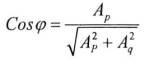
In there:
Ap : Active electric energy during the meter reading cycle (kWh);
Aq : Reactive power received during the meter reading cycle is the amount of reactive power consumed by electrical equipment during the time between two meter readings (kVArh).
Electricity buyers signing a contract for multiple electricity meters with the same line covering the points, the effective electricity and the reactive power shall be the total effective electricity output of such meters.
- In case the electricity buyer uses electricity for purposes other than production and business, the cosφ factor shall be determined is as follows:
a) In case of a separate meter, reactive power obligations shall only be applied to the above stated production and business purpose usage of power.
b) If there is a general meter (mixed usage), if the power factor cosφ < 0.9, the electricity buyer must purchase reactive power for the electricity used for production and business purposes. The electricity used for production and business purposes is determined based on the general metered electricity output minus the electricity output used for other purposes calculated based on the capacity used and the time of use of electrical equipment serving other purposes as per the PPA/sale contract for reactive power.
Formula to calculate the cost of purchasing reactive power:
In there:
T q = T p x k%
T q : Reactive power purchase price (excluding VAT);
T p : Cost of purchasing effective electricity (excluding value added tax);
k: Coefficient of compensation for costs due to the electricity buyer using more than the prescribed amount of reactive power (%), determined according to the following table:
|
Power factor Cosφ |
k (%) |
Power factor Cosφ |
k (%) |
|
From 0.9 and up |
0 |
0.74 |
21.62 |
|
0.89 |
1.12 |
0.73 |
23.29 |
|
0.88 |
2.27 |
0.72 |
25 |
|
0.87 |
3.45 |
0.71 |
26.76 |
|
0.86 |
4.65 |
0.7 |
28.57 |
|
0.85 |
5.88 |
0.69 |
30.43 |
|
0.84 |
7.14 |
0.68 |
32.35 |
|
0.83 |
8.43 |
0.67 |
34.33 |
|
0.82 |
9.76 |
0.66 |
36.36 |
|
0.81 |
11.11 |
0.65 |
38.46 |
|
0.8 |
12.5 |
0.64 |
40.63 |
|
0.79 |
13.92 |
0.63 |
42.86 |
|
0.78 |
15.38 |
0.62 |
45.16 |
|
0.77 |
16.88 |
0.61 |
47.54 |
|
0.76 |
18.42 |
0.6 |
50 |
|
0.75 |
20 |
Below 0.6 |
52.54 |
- Payments for reactive power shall be in parallel with the payments for active power, same analogy is applied for the debt settlement.
Power Purchase and Sale for Domestic Use
Legal/authorised representatives of the electricity buyer and the electricity seller in their legal capacity to enter into electricity purchase and sale contracts.
In case of group users contracts i.e. multiple households, the representative shall be among them and such person shall obtain written authorization from the other such households. The said contract to attach a list of such households with the electricity pricing.
If the electricity buyer is a tenant, landlord shall be the contracting party or the tenant as authorized by the landlord and undertaking payment obligations of the tenant.
Meter Readings – Electricity Seller Must Ensure Accuracy
For domestic use – the electricity seller to record meter reading on a monthly basis on a fixed date agreed in the power purchase and sale contract, except in cases of force majeure, with a cushion to move such date by one prior or later or agree to shift in accordance with the said power contract.
For non-domestic use – the buyer and seller are allowed to agree on the number of times the electricity meter is recorded on a monthly basis. In a scenario of disagreement, the recording of the electricity meter is regulated based on the average electricity consumption registered in the electricity purchase and sale contract as follows:
a) Under 50,000 kWh/month, record the index once a month;
b) From 50,000 to 100,000 kWh/month, record the index twice a month;
c) Over 100,000 kWh/month, record the index three times a month.
If the average actual electricity consumption of the electricity buyer in the last three (03) months exceeds or is lower than the consumption thresholds corresponding to the number of times the index is recorded as stated above, the electricity seller and the electricity buyer can agree on the number of times for recording the electricity index.
Electricity buyers using less than 15 kWh/month, the contracting parties to mutually decide on the electricity metering cycle. Whereas, for wholesale electricity purchase and sale, the recording meter readings shall be as per contractual agreement.
Transition
Electricity purchase and sale contracts signed before February 08, 2025 shall continue to be implemented as signed. For Customers who have performed contract security as per Decree No. 137/2013 of the government, such Customers have the right to request the electricity seller to amend the electricity purchase and sale contract according to Decree 18.